GDPR & Image Hosting: What EU Users Need to Know
PicGlobe Team
WEBXO TECH LTD · August 2026
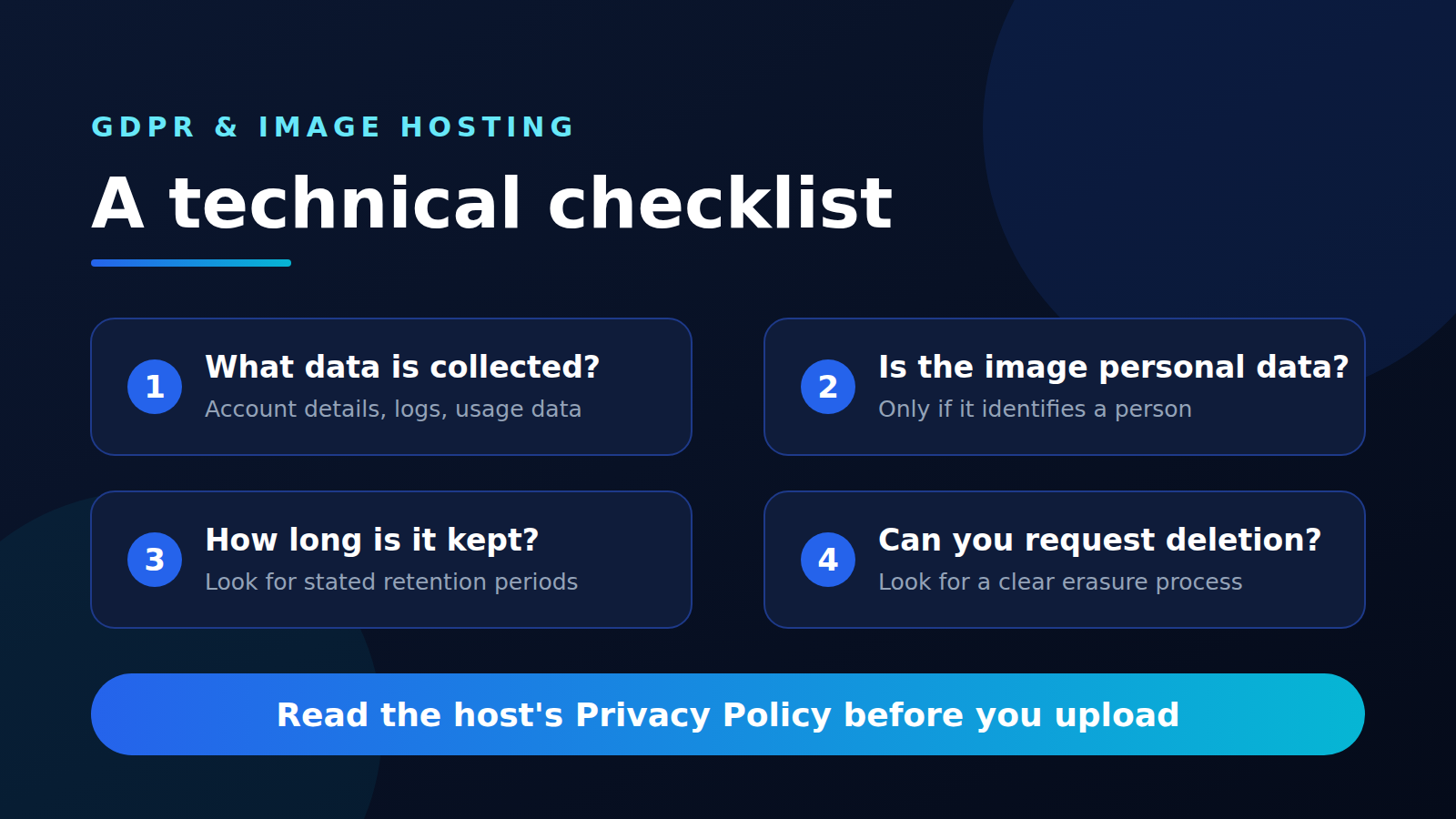
An uploaded image itself is rarely "personal data" under GDPR unless it identifies a person — but the account and usage data tied to a hosting service usually is, and that's what GDPR compliance actually governs. Knowing the difference helps you evaluate any image host, not just PicGlobe.
What GDPR actually requires from a service
| Requirement | What it means in practice |
|---|---|
| Right to erasure | You can request deletion of your data, including uploaded content tied to an account. |
| Data minimization | The service should only collect what it actually needs to function. |
| No unauthorized data selling | Personal data can't be sold to third parties without a clear legal basis and consent. |
| Encrypted handling | Data should be protected in transit and at rest with appropriate security measures. |
What PicGlobe's Privacy Policy states
The table below summarises PicGlobe's published Privacy Policy as of October 2026. It is a summary rather than legal advice, and the Privacy Policy itself is the authoritative text.
| Topic | What the policy states |
|---|---|
| Operator | A company registered in England and Wales |
| IP addresses | Retained for a maximum of 30 days, for security and abuse prevention |
| Account data | Kept for the life of the account, plus 30 days after deletion |
| Erasure | Users can request deletion under Article 17 of UK GDPR |
| Response time | Requests are answered within 30 days |
| Processors | Cloudflare (R2 and CDN for image storage and delivery) and PayPal (payments) |
UK GDPR vs EU GDPR — an important distinction
Since Brexit, the UK operates its own UK GDPR, which is closely modeled on the EU's GDPR but is a legally separate framework. A service being UK GDPR compliant follows very similar principles to EU GDPR, but if you specifically need confirmation of EU GDPR certification for a business or legal requirement, it's worth checking a service's terms and privacy policy directly rather than assuming the two frameworks are interchangeable.
How to check any image host's compliance yourself
- Read the privacy policy — it should clearly state what data is collected, why, and for how long.
- Look for a way to delete your data — a legitimate service makes this straightforward, not buried or unavailable.
- Check where servers are located — data residency matters for certain compliance requirements.
- Avoid uploading identifiable personal images you're not comfortable being stored, regardless of a platform's stated compliance — policies describe intent, not a technical guarantee against all risk.
Frequently asked questions
What does PicGlobe's Privacy Policy say about data retention?
According to PicGlobe's Privacy Policy, IP addresses are retained for a maximum of 30 days, and account data is kept for the life of the account plus 30 days after deletion. See the Privacy Policy for the full list and for how to request deletion.
Does an uploaded image count as personal data under GDPR?
Only if the image itself identifies a person (like a photo of someone's face). A landscape or product photo generally isn't personal data on its own.